
Author: Adrian Webersinke
General information
Address
Minoritenplatz 1, 1010 Vienna
Website
https://www.oesta.gv.at/ueber-uns/abteilungen/haus-hof-und-staatsarchiv1.html
Contact
hhsta@oesta.gv.at
Brief history
The Haus-, Hof- und Staatsarchiv (HHStA) was founded in 1749 by Empress Maria Theresa of Austria as the central archival institution of the Habsburg dynasty. The aim was to consolidate scattered document holdings to legally secure dynastic rights and enable professional administration of the increasingly complex imperial apparatus. The original location was in the Imperial Chancellery of the Hofburg. Until the end of the monarchy in 1918, the HHStA developed into the central archive of the imperial administration, diplomacy and Habsburg household affairs.
Holdings
The archive comprises approximately 16,000 linear shelf metres with around 130,000 registers and administrative files, 75,000 documents, about 15,000 maps and plans, as well as approximately 3,000 manuscripts. The temporal scope ranges from the High Middle Ages to the end of the monarchy. In terms of content, the holdings cover nearly all areas of Habsburg rule – from diplomatic correspondence to the administration of distant territories. Emphasis is placed on the history of the House of Habsburg, the activities of the highest court offices, the imperial cabinet and supreme imperial council authorities, the diplomacy and foreign policy of the Danube Monarchy, as well as the administration and jurisdiction of the Holy Roman Empire until 1806.
Structure and access
The HHStA is part of the Austrian State Archives, which is organisationally subordinate to the Federal Chancellery. It is a historical final archive without ongoing new additions (end point: 1918).
The holdings of the HHStA are divided into eleven main groups or departments, many of which originated from independent collections. The Imperial Archives (ca. 14th century – ca. 19th century) are the prime group of the collection. Other archival departments include Diplomacy and Foreign Policy before 1848, and from 1848 to 1918; the Habsburg-Lorraine Family Archives (12th century–1918); the Cabinet Archive, which holds administrative records (1523–1917); Court Archives, Private and Family Fonds (12th century–1922); the Document Series, Seal Casts and Type Collections, which hold copies and prints of treaties (816–1918); the Manuscript Collections (ca. 800 – ); Regional Departments (1123–1850); and Reproduction Collections (ca. 1970 – ). Special collections include the Estates, Family and Lordship Archives (1180–2005).
Digitised materials exist partially, but a systematic digitisation has not been completed. However, the entire holdings of the HHStA are catalogued in the Austrian State Archives’ Archive Information System (AIS). While the AIS integration is practical, it is important to check where a document is actually located, as there is a physical division between the HHStA (located at Minoritenplatz) and the other four departments of the State Archives (which are all located in Erdberg).
The archive is publicly accessible. Registration is required for use. Opening hours, user regulations, and registration details are available on the website.
Connected collections
In Vienna, related collections can be found at the Austrian National Library, particularly in its map, manuscript, and papyrus holdings. Additional material is preserved in the WStLA, as well as in the archives of religious orders such as the Jesuits. Important sources are also held in the private archives of noble families, while the Weltmuseum Wien and the Volkskundemuseum (Austrian Museum of Folk Life and Folk Art) house further relevant collections.
What makes this collection global?
The holdings of the HHStA document the worldwide political, economic, and cultural entanglements of the Habsburg monarchy. The diplomatic correspondences in particular reflect contacts with Europe, the Ottoman Empire, Asia, and the Americas. Topics such as migration, colonial interests (e.g., through dynastic connections with Spain), trade networks, and imperial expansion can be traced in the sources.
Limits arise from the administrative perspective: this is a European-imperial view that barely makes subaltern voices visible. If actors from non-European regions feature at all, they mostly do so in dependence on European interests.
Exemplary primary source


(“Copy of the condolence and congratulatory letter from the King of Morocco Mulej Muhamed ibni Mulei Abdullah ibni Mulej Ismail”)

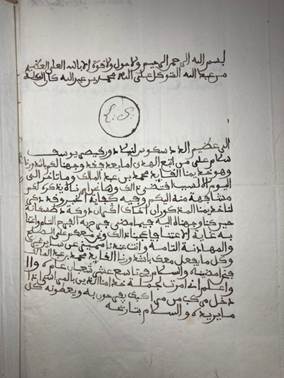
(“Copy of the second credit letter regarding the establishment of a peace and friendship treaty”)
Locator: „Marokkanische Gesandtschaft nach Wien: Berichte, Noten, Vorträge, Handschreiben. Verzeichnis der Personen der Gesandtschaft, Korrespondenzen mit Zentralbehörden, Anrede des Botschafters an den Kaiser bei der Antrittsaudienz, Verzeichnis der Geschenke.“ 1782 – 1784. Accession number: AT-OeStA/HHStA StAbt Marokko 4-1
An example of the global reach of the Habsburg monarchy is the Moroccan mission to Vienna of 1783, documented in the HHStA holdings but also present in visual, textual, and material media of the time (newspapers, copper engravings, porcelain).
The Moroccan mission, which aimed to conclude a peace, friendship, and trade treaty with Kaiser Joseph II, is an example of cross-cultural diplomacy and ceremonial exchange. The documents in the HHStA provide insights into diplomatic practices and courtly ceremonies and the reception of such events in urban public life.
They reveal, for instance, how ritualised encounters were carefully staged to communicate both equality and hierarchy, and how the imperial court sought to inscribe itself into global networks of power and commerce. Beyond the courtly framework, the wide dissemination of the event in engravings, press reports, and decorative objects illustrates how diplomacy was transformed into a public spectacle, shaping perceptions of the monarchy’s cosmopolitan reach. In this sense, the mission opens perspectives not only on the mechanics of negotiation and ceremony but also on the production of imperial self-representation and the entanglement of global politics with urban media cultures.
Further reading
Agstner, Rudolf. Von Kaisern, Konsuln und Kaufleuten, vol. 2: Die k. (u.) k. Konsulate in Arabien, Lateinamerika, Lettland, London und Serbien. Vienna: Lit, 2012.
Auer, Leopold, ed. Quellen zur Geschichte Afrikas, Asiens und Ozeaniens im Österreichischen Staatsarchiv bis 1918. Guides to the Sources for the History of the Nations, 3rd ser., vol. 8. Munich: Saur, 1986.
Agstner, Rudolf. Handbuch des k. (u.) k. Konsulardienstes: Die Konsulate der Donaumonarchie vom 18. Jahrhundert bis 1918. Edited by Gerhard Gonsa. Vienna: New Academic Press, 2018.
Häberlein, Mark. Die Marokkaner in Wien: Interkulturelle Diplomatie und städtische Öffentlichkeit im Zeitalter Josephs II. Stuttgart: Franz Steiner, 2024.