
Author: Maria Döring
General information
Address: Wipplingerstraße 6-8, 1010 Vienna
Website: https://www.doew.at/erforschen/recherche/archiv/spanienarchiv
Contact: spanienarchiv@doew.at
Brief history
The Spanienarchiv (“Spain Archive”) is a special collection and an independent archive body within theDokumentationsarchiv des Österreichischen Widerstandes (DÖW, Documentation Centre of Austrian Resistance). The DÖW is an association founded in 1963 by resistance fighters and victims of persecution under the Nazi regime, along with historians working towards a broader societal reckoning with the period. It deals primarily with resistance and persecution during the Nazi era, restitution and compensation after 1945, and right-wing extremism until the present day. Its main task is to collect and archive relevant sources and to provide advice and support to interested parties.
The Spanienarchiv was founded in 1984 by the former Spanish volunteer fighter Hans Landauer (1921–2014). It includes copies of official documents and other sources about Austrians who fought as volunteers in the International Brigades on the side of the Spanish Republic against the putschists under Franco between 1936 and 1939, including photos, letters, newspaper articles and autobiographical texts from Austria and abroad. In many ways a prelude to World War II, the Spanish Civil War can be understood not only as a national event but also a global one. Volunteers from more than 50 countries fought on the side of the Republic, while the putschists received decisive military support from Hitler’s Germany and Mussolini’s Italy. The Spanish Civil War can thus be seen as an international proxy war that revealed the political and ideological divisions in interwar Europe.
After his retirement in 1983, Hans Landauer became a volunteer at the DÖW, where there were already plans for a publication on the Spanish Civil War to mark the 50th anniversary of Franco’s coup d’état. He began to collect documents about Austrians on the side of the Spanish Republic and eventually published a volume entitled “For Spain’s Freedom” in 1986. The research was based on the so-called “Archive of the Austrian Interbrigades”, which was compiled by the former Spanish Civil War volunteer Josef Gradl and is now held in the KPÖ party archive.
From these beginnings, the Spanienarchiv emerged as an independent archive body. Thanks to Hans Landauer’s independent efforts to research documents abroad, it became the world’s largest archive on any national contingent of volunteers in the Spanish Civil War. Its holdings, mostly as archival copies, were collected from other archives in Austria, Spain, Germany and the Netherlands. After the collapse of the Soviet Union, the archive was expanded in the 1990s with documents from Russia and East Germany. Those of the former Soviet Union and the GDR contain sources about volunteers living there in exile, while parts of the contemporary archives of the International Brigades in Spain were brought to Russia after Franco’s victory.
It was only in 2012/13 that the archive’s holdings were systematically catalogued and organised as part of a project initiated by theVereinigung Österreichischer Freiwilliger (Association of Austrian Volunteers), as Landauer’s original bequest was not systematised; he had been using the files exclusively for his own research. In recent years, the collection has been expanded with a focus on women’s biographies.
Holdings
The Spanienarchiv comprises documents relating to the lives of Austrian volunteers in Spain. Not only the timespan 1936 to 1939 in Spain is considered, but the volunteers’ entire biographies, with a focus on their political life. The archival holdings can be divided into six main sections. The first section consists of sources relating to the fighting in Spain in general, e.g. maps of the front lines. The second section consists of sources relating to the International Brigades and the role of the Austrian brigade volunteers – this is the core of the collection. The third section consists of sources that deal with the internment of the International Brigades volunteers as prisoners of war in French camps. The fourth section contains files on those sent to German concentration camps. The fifth section contains sources that deal with the lives of the Austrian International Brigades volunteers before and after the Spanish War, like in the Republikanischer Schutzbund (“Republican Protection League”, the armed wing of the Austrian Social Democratic Workers Party), their migration after 1934, Soviet exile or roles in the French resistance. The sixth and last section documents how the Spanish resistance was received in the public sphere, e.g. on the basis of newspaper articles.
Structure and access
Since the creation of the archive, the main focus has been on personal profiles. From 36 catalogued estates of Austrian Spanish volunteers at the beginning, the collection has grown to include documents on almost 1400 Austrians. It is organised into individual personal dossiers consisting of all the sources relating to the person in question. The dossiers vary greatly in their scope but may contain military records, civil status lists, lists of prisoners from camps, victim welfare files, membership files of the Concentration Camp Association, memoirs, newspaper articles, scientific literature and similar documents. The collection consists mainly of German-language documents, but it also includes documents in Spanish, French and Russian.
The material of the Spanienarchiv was incorporated into the file signature of the DÖW in 2012/13. The entire collection is organised under the DÖW file number 25000, followed by a letter assigned to a subject area (A: Austrian and German authorities; B: Spanish War; C: French camps; D: German concentration camps; E: Resistance and exile; F: History of reception; G: Josef Toch estate; H: Josef Schneeweiß estate; I: Hans Landauer estate; J: Gerhard Hoffmann estate). These subject areas are further subdivided into subtopics by a consecutive number, whereby the subordinate subject areas are each assigned to a unit of one hundred (e.g. 101–199).
The archive can be visited on request via email. Once an appointment has been made, it is possible to visit the archive in person and view the requested files. Copies of the documents can be made by the DÖW for a fee.
The Spanienarchiv offers a wide variety of literature about the archive itself and the Brigade volunteers online on the DÖW website “Spanienarchiv online”. In addition, the same website hosts the Lexikon der österreichischen Spanienkämpfer 1936–1939 (“Encyclopaedia of Austrian Spain fighters, 1936–1939”). It contains 1400 short biographies of Austrian volunteers in Spain, some of which are accompanied by images.
Connected collections
First and foremost among the connected collections is the DÖW at large, which contains oral history interviews with volunteers from Spain. In addition, the DÖW’s photo collection contains many photographs from Spain, and the DÖW library offers around 1500 books on the Spanish War in various languages.
The archive consists of many copies of original documents that can be found elsewhere. In Vienna, the two most important are the Archive of the Republic and the Central Party Archive of the Communist Party. In the Archive of the Republic, the department of police files and the New Political Archive are particularly significant.
Furthermore, within Austria, the Landesgerichte (regional courts) in Feldkirch and Wiener Neustadt, as well as the corresponding regional archives of Vorarlberg and Lower Austria, are vital points of contact, as this is where most of the court files relating to the brigade volunteers are located. Internationally, archives in Germany, Spain and Russia are relevant.
What makes this collection global?
The global history aspect of the Spanienarchiv is particularly evident in the topics of emigration, exile and the International Brigades. The archive uses personal dossiers to trace life paths characterised by political persecution, emigration, exile and resistance. These paths lead from Austria to Spain, France, Germany, Russia and other European countries. This is also where the global historical limits of the Spanienarchiv lie, as it tells a purely European story. However, it should be noted that many volunteers within the International Brigades came from countries outside Europe. Nevertheless, as the Spanienarchiv focuses on Austrian volunteers, there is hardly any source material on non-European volunteers in this archive.
Another exciting global historical aspect in relation to the International Brigades is the Chapayev Battalion, which was the most diverse international battalion with 25 nationalities, including several Austrians. It was disbanded after just nine months, however, due to communication problems. Although the official language of the International Brigades was French, only very few could speak it, which is why the battalions were generally organised according to language groups. For example, attempts were made to place Slavic language speakers together in one battalion and not with people who only spoke Romance languages in order to avoid communication difficulties. Another global aspect is that the archive’s holdings were gathered from various collections throughout Europe.
Featured primary source
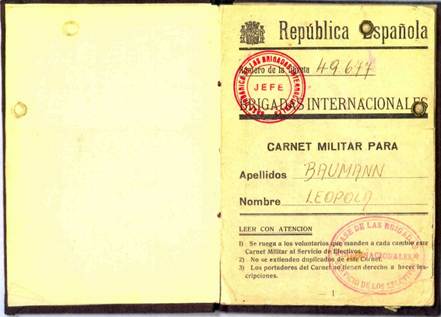
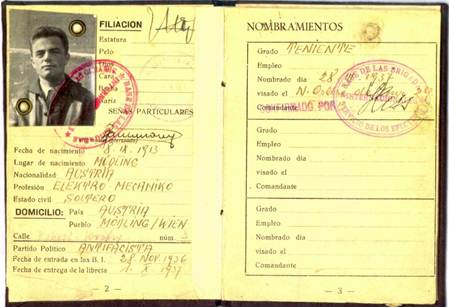
The copy of Leopold Baumann’s military identity card is well-suited as an exemplary source from the Spanienarchiv with points of connection to global history. It shows international cooperation among the International Brigades on the one hand and a history of emigration based on political convictions on the other. The source can be used to illustrate central themes of global history research, such as emigration and international resistance. In addition, it also shows the multilingualism within the International Brigades and the problems apt to arise from it. It should be noted that the source only becomes truly productive when it is embedded in the context of the history of the International Brigades in the Spanish War and the life story of Leopold Baumann.
In terms of global history, Leopold Baumann’s military identity card reveals a history of emigration and international co-operation based on shared political convictions. It documents one Austrian taking up arms in the anti-fascist struggle during the Spanish Civil War. The source illustrates the international solidarity mobilised for the war and the transnational political networks that made resistance thinkable. Indeed, this inspired mobilisation and militant volunteering networks around the globe for decades to come.
This military ID card is in Spanish. The name Leopold Baumann is noted on the front side in handwriting. The cover testifies to the fact that there were special military ID cards for the International Brigades, emblazoned with the words “República Española” and “Brigadas Internacionales”. This shows how the brigades were organised within the military of the Spanish Republic. The fact that the identity card was issued in Spanish and not French – the brigade’s actual official language – also shows the International Brigades’ integration into the Spanish Republic itself.
Inside the ID card is a photo of Baumann. The card also notes his date of birth, 8 September 1913, as well as his place of residence, Mödling in Austria, and that he was born there. Even the exact address is noted, albeit barely legibly. Baumann’s political affiliation is listed as “anti-fascist”. Other personal information includes the date he joined the International Brigades and the issuing date of the ID card itself, with almost a year in between. The card states that he holds the rank of lieutenant. Also noted is his marital status, unmarried, and that he was an electrician. What is striking is that his profession is not rendered in the standard Spanish spelling “electromecánico”, but rather in a mix of German and Spanish, namely “elektro mecaniko”. This indicates that the card was probably not written by a Spaniard and points to the linguistic diversity of the international brigades, but also to the difficulties that arise when there is no common language to communicate in.
Further reading
Mugrauer, Manfred. “Das Spanienarchiv im Dokumentationsarchiv des österreichischen Widerstandes.” In 80 Jahre Internationale Brigaden. Neue Forschungen über österreichische Freiwillige im Spanischen Bürgerkrieg, edited by Irene Filip. Vienna: Dokumentationsarchiv des österreichischen Widerstandes and Vereinigung österreichischer Freiwilliger in der Spanischen Republik 1936–1939 und der Freunde des demokratischen Spanien, 2016, 133–156.