
Author: Lisa Pairits
General information
Address: Fünfhausgasse 5, 1150 Vienna
Website: https://www.basis-wien.at
Contact: office@basis-wien.at
Brief history
Today’s basis wien – Forschungs- und Dokumentationszentrum für moderne und zeitgenössische Kunst (Documentation Centre for Contemporary Art) is based on the archive that was founded in 1997 by then federal curator Lioba Reddeker. She invited artists, curators and critics to deposit documentation of their work in the archive and set up media monitoring of the art scene in Austria. As early as 1999, an accompanying database was made accessible online and in 2011 the database was relaunched and modernised. Since 2013, the archive and the database have been expanded through the integration of the St. Pölten Art Collection Centre, as well as other smaller collections, thereby also increasing their reach.
Holdings
Basis wien defines itself as a documentation centre; its collection consists of an archive and a library, as well as an extensive database. In terms of content, basis wien deals with contemporary art in and from Austria, while also taking its international contexts into account. The aim of the collection is the documentation of Austrian art events and art discourse at various levels.
The archives of basis wien consist mainly of so-called ephemera – objects made for short-term use, such as invitations, program booklets, posters, videos, press material and the like. The archive also contains unpublished materials, including private notes and grey literature, which were given to basis wien by the artists, curators, and critics themselves. In addition to the archive, basis wien has a reference library with an extensive collection of exhibition catalogues, monographs and theoretical works on contemporary art as well as a selection of Austrian and international art magazines.
Structure and access
The archive and library holdings are listed in the digital art and research database and are publicly accessible. The data records are divided into six categories – events, people, institutions, publications, works and archival material – and supplemented by carefully researched framework information when fed into the database. According to the archivists, “[t]he complex interlinking of all data creates a dynamic picture of the diverse production contexts of the Austrian art scene since 1945.” Since 2011, there have been extended search functions that simplify more complex queries through sorting and filtering options and, where possible, previews. In the case of shorter contributions, complete digital copies are also made available. There are no plans for the full digitisation of all archival materials; however, each individual object in an archive bundle or folder is individually numbered and named and can thereby be found in the database.
Physical objects and originals can be accessed in the reading room of basis wien by appointment only. Materials that are linked in the database but belong to separate institutions also must be requested individually and can then be accessed in the corresponding location.
Connected collections
The collection of basis wien is related through its subject matter to the numerous Viennese museums which hold contemporary art, including mumok, Künstlerhaus, Secession, Wien Museum, MAK and Belvedere. However, a unique attribute of basis wien is the documentation of projects outside the scope of big museums and galleries which can be found in off-spaces and other artist-run initiatives. These frequently feature young, up-and-coming artists, and the monitoring of art students and new graduates also leads to an overlap with the holdings of the archives of the University of Applied Arts and the Academy of Fine Arts in Vienna.
basis wien also actively cooperates with other institutions in and outside Vienna by including their collections in the basis wien database, such as the Sammlungszentrum Kunst St. Pölten, Archive IntAkt (International Action Group of Visual Artists) and Library Haus des Widerstands/ Haus Feuerlöscher. International cooperations also connect basis wien to the Archive of Fine Arts Prague, Moderna Galerija Ljubljana, Artpool Art Research Center Budapest, and MNAC National Museum of Contemporary Art Bucharest, among others. To be emphasised is a network project with the aim to decentralise archive content, which was made possible by the European Commission’s Culture 2000 funding program. The successor project to this initiative, which has been running since 2002, is the European Art Net (EAN) – a highly influential research tool to this day, which was initiated and is still coordinated and chaired by basis wien.
What makes this collection global?
While the focus lies in the documentation of the art scene in and from Austria, the consideration of the international context is a declared aim of basis wien. Therefore, basis wien provides a good platform for analysing the (global) interconnectedness of art networks, in particular through the links between people, institutions, and events revealed by the database. The comprehensive inventory (data on 112.700 persons, 19.212 institutions, 80.720 events and 12.0257 objects are currently recorded) enables both qualitative and quantitative approaches.
A potential limitation for global history research lies in the highly specific documentary mission of basis wien, which is clearly focused on the field of contemporary art, albeit broadly defined. However, it is not an archive of the art market, which means that classic global history research projects such as analysis of trade routes based on auction catalogues, invoices and contracts cannot be undertaken solely based on basis wien’s holdings. Instead, they offer an insight into the inter- and transnational movement of artists and artworks through exhibition projects and collaborations between individual actors as well as cultural institutions. Through the hyperlinks in the database, artworks and events are frequently directly tied to their reviews and critiques from local as well as international sources, thereby making the wider reception history easily accessible. Furthermore, basis wien is a valuable resource for observing the zeitgeist in art, which often transcends national borders and provides the possibility of discovering trends, overarching themes, and common issues being addressed through art.
Featured primary source
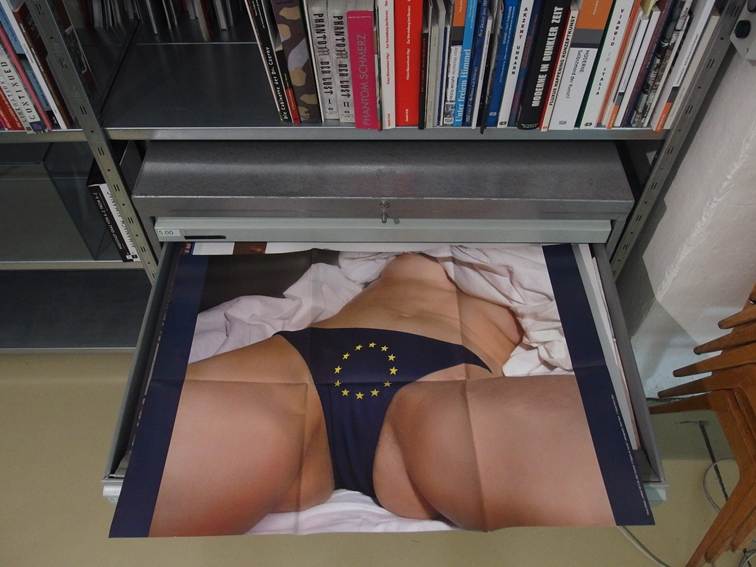
The poster above is an artwork by the Serbian artist Tanja Ostojić. An enlarged version was exhibited on rolling boards in Vienna and Salzburg as part of the project EUROPART – contemporary art from Europe, curated by Ursula Maria Probst and Walter Seidl. Two works each from 75 artists from 25 EU-countries were shown in this manner in the period from 27th of December 2005 to 30th of January 2006. EUROPART was part of the bigger project series 25 Peaces which was initiated to celebrate three jubilees in Austria: the founding of the second republic 1945, the state treaty 1955 and the accession to the EU 1995.
Tanja Ostojić is a performance and interdisciplinary artist, researcher and educator whose works deal with topics such as gender politics, feminism, migration, displacement, labour and ethical participation. Her projects often include institutional critique and are politically engaged. The artist has described After Courbet as a reference to Courbet’s classic work not only in composition but also to his position as an artist who thematised class struggle and the freedom of art. She takes a critical stance towards the EU as an institution that not only holds control over its citizens but also non-citizens, for example through immigration policies and hurdles for marriages between EU- and non-EU partners.
“In certain periods in history, nudity revolved in the public mirror, but taken for its symbolic value in society it frequently served as a carrier for other messages.”
This statement by Tanja Ostojić already opens up different layers of interpretation for her artwork After Courbet. Firstly, the context of Gustave Courbet’s L’Origine du Monde which itself caused scandals in the 1860s since it was painted by the French artist on a commission for the Ottoman diplomat and collector Khalil Bey. While explicit depictions of female nudes and even close-ups of the vulva were not unheard of, Courbet’s piece was uncommon as it portrayed the voyeuristic scene in an almost gynaecological manner, with spread thighs and prominent pubic hair but without any mythological, historical or moralistic narrative. The painting’s provenance and illustrious owners in France and Hungary throughout time added to its appeal, especially since it was often presented in a secretive manner, hidden behind a veil or other artworks and thereby gaining an even more scandalous reputation.
In comparison, Tanja Ostojić’s photography seems almost tame, with dark blue panties covering her clean-shaven vulva. However, the twelve golden stars of the EU flag on the blue fabric made it a highly political statement, even more so due to the context of the 2004 EU expansions of 10 mostly eastern European countries. While countries like Poland, Hungary, and the Czech Republic gained access to the European Union and the right to move freely within its borders, citizens of non-member states like Serbia, Tanja Ostojić’s country of origin, continued to face visa restrictions. Despite this underlying message, the artwork was heavily criticised for its portrayal of nudity and was removed from the exhibition EUROPART after only two weeks. Boulevard media as well as regular newspapers covered the story, broadening the discussion to include questions about the lawful use of taxpayers’ money and the freedom of art. The database of basis wien alone shows 55 publications in various Austrian news outlets on the matter, international coverage, on the other hand, remained scarce. Issues surrounding the perceived desecration of the EU flag were largely confined to the immediate surroundings of the project in Austria.
Another noteworthy aspect is that EUROPART can be seen in the bigger context of the 2000s art scene which saw an influx of exhibitions with and about artists from the new EU states after 2004. The “Art Archives Study. Before and after 2004” has further found out that the EU enlargement has led to greater artistic mobility in the countries studied. Therefore, Tanja Ostojić’s After Courbet and the surrounding debates documented by basis wien demonstrate how contemporary art and art discourses can serve as a valuable resource for global history, revealing how individual artistic expressions throughout time are entangled with transnational power structures, cultural borders, and contested narratives of belonging.
Further reading
basis wien, Archive of Fine Arts, Prague, and Moderna galerija Archive Department. Art Archives Study. Before and after 2004. Accessed June 8, 2026. https://www.basis-wien.at/avdt/pdf/125/00154022.pdf
Ostojić, Tanja.After Courbet. 2004. URL: https://tanjaostojic.com/after-courbet-2004/
Mahon, Alice. “Why Courbet’s The Origin of the World is so popular—and it’s not what you think.” The Art Newspaper, December 21, 2016. Accessed June 8, 2026. https://www.theartnewspaper.com/2016/12/21/why-courbets-the-origin-of-the-world-is-so-popularand-its-not-what-you-think.